Big University vs Small College: Which One Actually Fits You
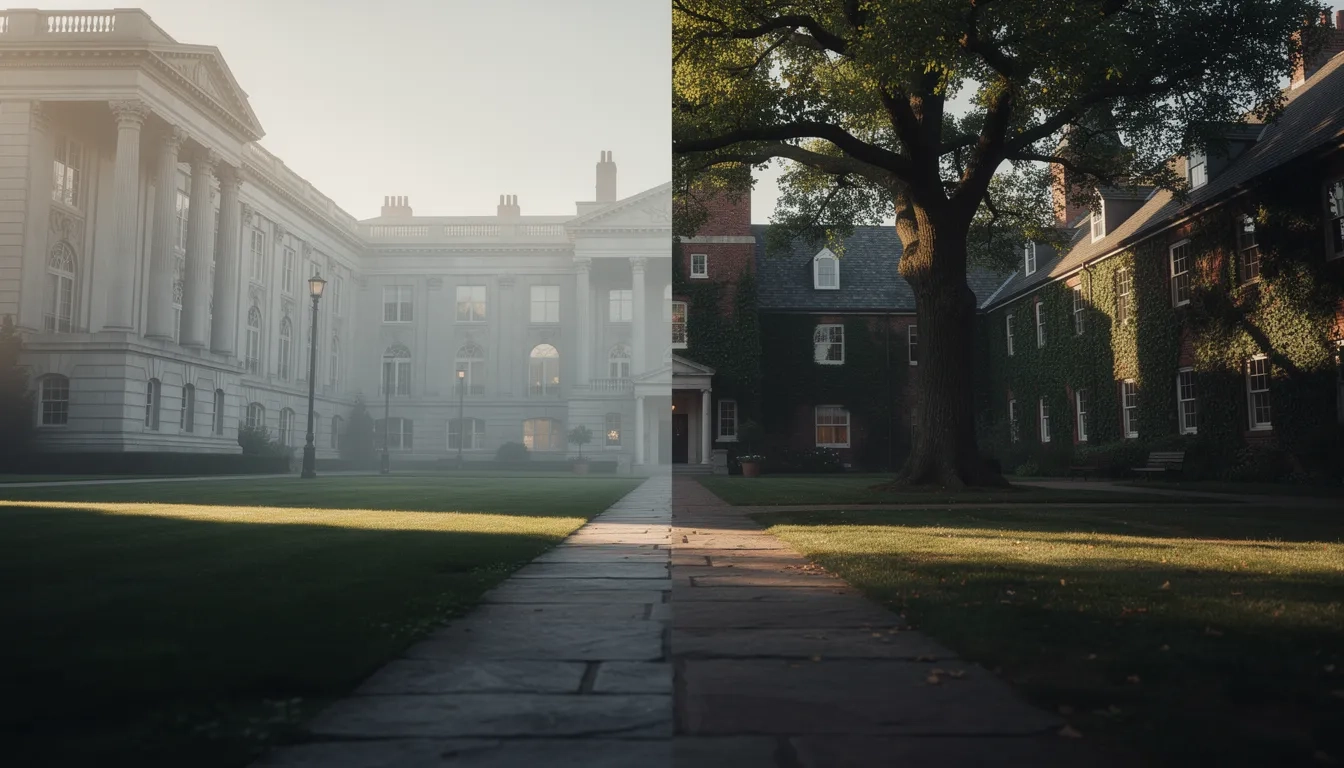
Penn State's Schreyer Honors College has fewer than 2,000 students inside a university of roughly 86,000. That's not a typo — it's a workaround. Thousands of families every year discover that "big vs. small" isn't really a binary at all, and the schools that figured that out first are now the ones eating everyone else's enrollment lunch.
Here's the twist nobody tells you at the college fair: since 2011, enrollment at most types of U.S. colleges has shrunk by close to a third, while schools with 20,000-plus students grew by about 19%, adding more than three-quarters of a million students in the same stretch. Big is winning the enrollment race. That doesn't mean big is winning the fit race for every kid — it means the calculus has gotten more interesting than "cozy campus" versus "football Saturdays."
What "Big" and "Small" Actually Mean in Numbers
Before you can compare, you need real thresholds, because "big" and "small" get thrown around loosely in brochures.
- Small: under 5,000 undergrads (think Swarthmore, Bowdoin, Pomona)
- Medium: 5,000–15,000 (Tufts, Georgetown, Rice)
- Large: 15,000+ (UCLA, Michigan, UT Austin)
The number that matters more than total headcount, though, is student-to-faculty ratio. Schools with a ratio of 10:1 or below graduate students at a 60.7% rate; schools above 25:1 graduate just 41.8%, according to graduation-rate data compiled by BestColleges. That's not a rounding error — that's a nearly 19-point swing tied almost entirely to how much individual attention a student gets.
A 70% graduation rate at a broad-access public university can signal stronger institutional support than a 90% rate at a school stacked with valedictorians who'd have graduated anywhere.
That quote is worth sitting with. Raw graduation rates measure the student body's starting point almost as much as the school's teaching. Don't let a shiny percentage substitute for asking what actually happens once you enroll.
The Class Size Myth (and the Research That Complicates It)
Everyone assumes small classes automatically mean better learning. The data is messier than that.
The National Survey of Student Engagement pulled responses from more than 355,000 students at 622 four-year institutions in 2014 and found that enrollment size "bears little relationship" to how engaged students actually feel with faculty and coursework. So why does the small-college pitch persist?
Because averages hide the two very different experiences inside a large university. Your intro chemistry lecture might have 400 people in it, taught by a TA who's also finishing a dissertation. Your junior-year seminar in your actual major might have 12 people and a full professor who remembers your name. Big schools aren't uniformly impersonal — they're unevenly personal, and which version you get depends on your major, your year, and honestly, your willingness to show up to office hours.
Small colleges flatten that variance. Every class, every year, tends to run 15–25 people. That consistency is the actual product you're buying, not just "small classes" as a slogan.
Where the Gap Is Real
- First two years: large universities show the widest gap — gen-ed lecture halls versus small-college seminars from day one
- Junior/senior year in a popular major: gap narrows fast, especially in STEM fields with capped lab sections
- Registration bottlenecks: large universities are more prone to closed sections delaying graduation, a structural hurdle small colleges mostly avoid
Research Access: More Opportunities vs. Less Competition
This is the tradeoff nobody frames correctly. It's not "who has more research" — both do, in different shapes.
Research universities have the volume: state-of-the-art labs, federally funded projects, and named centers with real budgets. The catch is you're competing against grad students and postdocs for a spot on those teams, and as a freshman you're often assisting rather than leading. Liberal arts colleges flip the ratio — fewer total projects, but since there's no graduate program siphoning off the interesting work, undergrads get first crack at running their own experiments, often as sophomores.
| Factor | Large Research University | Small Liberal Arts College |
|---|---|---|
| Volume of research projects | High — dozens of active labs | Lower — dozens, not hundreds |
| Who runs the work | Often grad students/postdocs, undergrads assist | Undergrads frequently lead, faculty mentor directly |
| Funding & equipment | Well-resourced, cutting-edge labs | Leaner budgets, fewer specialized facilities |
| Competition for a spot | High | Lower |
| Time to first real research role | Junior/senior year, typically | Sophomore year, often |
If your goal is a specific named lab (say, an MIT robotics group), the university wins outright. If your goal is having done real, independent research by the time you apply to grad school, the small college often gets you there faster.
The Cost Comparison Everyone Gets Backward
Sticker price lies to you, and it lies in a specific, predictable direction.
For 2025–2026, average tuition and fees run about $11,371 for in-state public, $25,415 for out-of-state public, and $44,961 for private colleges, according to U.S. News data. Scary numbers. But net price — what families actually pay after aid — tells a different story: $15,910 for public in-state, $29,570 for public out-of-state, and $33,980 for private nonprofit.
Out-of-state public university is frequently the worst financial deal in American higher ed. You lose your home-state tuition break but don't gain the deep institutional aid that private schools dangle to compete for students. At $29,570 net, out-of-state public costs only about $4,400 less per year than a private college's average net price — and that's before scholarships specific to you.
Here's the part that surprises families every year: elite private schools with big endowments can be cheaper than a state school. Harvard's average net price sits around $5,800 a year. Stanford's is close to $6,200. Rice comes in near $8,900. Small colleges often have larger per-student institutional aid budgets precisely because they're competing hard for every enrollee.
The one non-negotiable move here: run the net price calculator on every school on your list before you fall in love with a campus tour. Sticker price is marketing. Net price is math.
The Honors College Hack
If you're torn, there's a third option that splits the difference, and it's the fastest-growing trend in the "which size" debate right now.
Honors colleges embedded inside large universities give you small-school intimacy with big-school resources. Most honors seminars cap at 15 to 20 students — closer to a liberal arts classroom than a state-school lecture hall. Schreyer at Penn State, the University of Houston's Honors College, and Kansas's University Honors Program all pitch versions of the same idea: priority registration, specialized housing, dedicated advisors, and a built-in cohort of peers who actually want to be in the reading-heavy seminar.
- You keep: research funding, Division I athletics, huge alumni networks, dozens of majors to switch between
- You gain: small discussion sections, faculty mentors who know your name, a community that doesn't get lost in 86,000 people
- You risk: honors requirements (thesis, extra credits) that add workload, and losing honors status if your GPA slips
It's not free lunch — you're trading some flexibility for the hybrid experience. But with in-state tuition and merit money stacked on top, honors colleges can end up cheaper than a small private school while delivering a genuinely comparable classroom experience.
A Framework for Actually Deciding
Stop asking "which is better." Ask these instead, in order.
- How do you learn best? If you need to be pushed to speak up, a 300-person lecture will let you disappear for four years. If you thrive with structure and independence, that same lecture is just efficient content delivery.
- How settled is your major? Undecided or likely-to-switch students benefit from a large university's dozens of options. Locked-in students (nursing, a specific engineering track, a niche language) should check that the small college even offers it before applying.
- What's your actual net price, not sticker price? Run the calculator. Twice.
- Do you want research experience or research proximity? Leading your own project by sophomore year versus being near Nobel-caliber labs are different goods.
- Would an honors college solve this for you? If yes, you've likely found your answer — and your best financial deal.
Bottom Line
- Run net price calculators on every school before ranking by sticker price — out-of-state public schools are often the hidden expensive option.
- Check student-to-faculty ratio, not just total enrollment — it correlates more tightly with graduation outcomes than campus size does.
- Ask how many undergrads lead their own research at each school, not just how many labs exist.
- Investigate the honors college option at any large university on your list before ruling it out for feeling too big.
- The single biggest lever isn't size — it's whether you'll actually walk into office hours, join the small seminar, and use the resources sitting in front of you. Size just changes how much effort that takes.
Frequently Asked Questions
Is it easier to get into a small college than a large university?
Not necessarily — some small liberal arts colleges (Swarthmore, Pomona) are more selective than large public flagships. Acceptance rates depend on the specific school's reputation and applicant pool, not its size. Always check individual admit rates rather than assuming size predicts selectivity.
Do employers care whether I went to a big university or small college?
Mostly no, once you're a few years into your career — employers weight your major, internships, and portfolio far more than campus size. Name recognition matters more in the first job search, and large universities often have bigger regional alumni networks that help there. Small colleges tend to compensate with tighter, more personal alumni connections in specific industries.
Can I get a small-college experience at a big university without transferring?
Yes — honors colleges, living-learning communities, and small departmental majors inside large universities routinely deliver 15–20 person classes and dedicated advisors. Schreyer Honors College at Penn State and the University of Houston's Honors College are two well-known examples. Ask any large university's admissions office specifically about honors college acceptance rates and requirements.
Is a small college a worse deal financially than a large public university?
Often the opposite is true. Private colleges with large endowments frequently discount tuition so heavily through institutional aid that their net price undercuts an out-of-state public university's net price. Never compare schools by sticker price alone — always run each school's net price calculator with your actual financial information.
Do large universities really have worse teaching in the first two years?
The data is mixed. NSSE's large-scale 2014 survey found that institution size "bears little relationship" to student engagement, but large universities do rely more heavily on teaching assistants for intro-level lecture courses. The real predictor is student-to-faculty ratio and how proactive you are about seeking out office hours, not size alone.
What size college is best for an undecided major?
Large universities generally serve undecided students better because they offer dozens of majors under one roof, letting you switch tracks without transferring schools. Small colleges can work too if they have strong advising and enough breadth in their catalog, but check the specific major list before assuming you can explore freely.
Sources
- NSSE 2014 finds size, selectivity make little difference in student engagement
- College Graduation Rates: Full Statistics | BestColleges
- Big vs. Small Colleges: Pros and Cons | Empowerly
- The Cost of Private vs. Public Colleges | U.S. News
- College List: 5 Honors Programs to Make Big Schools Feel Smaller | Galin Education
- Liberal Arts College vs Research University | CollegeVine